


Two products, one well programme
Barite holds the mud weight while the hole is drilled; Class G cement seals the casing once it is. A failure in either costs rig time, which is why both are bought on a batch certificate rather than a product name, and why it pays to qualify them together.
API 13A barite: the certified 4.20 results
Density is the number barite is bought on. The viscosity pair either side of a gypsum addition is the one that shows whether the mud will still pump after meeting anhydrite downhole.
| Test | Acceptance limit | Result |
|---|---|---|
| Density | min 4.20 g/cm³ | 4.21 g/cm³ |
| Retained on No. 200 sieve (75 µm) | max 3 wt% | 2.04 wt% |
| Retained on No. 325 sieve (45 µm) | 10 ± 5 wt% | 10.7 wt% |
| Alkaline earth metals as calcium | max 250 ppm | 160 ppm |
| Apparent viscosity, before gypsum | max 125 cP | 97.5 cP |
| Apparent viscosity, after gypsum | max 125 cP | 112.5 cP |
| Clay content | max 3 lb/bbl | 2.75 lb/bbl |
Tested to API 13A and NISOC methods by an ISO/IEC 17025 accredited drilling-fluids laboratory. The 4.10 grade, an economy weighting agent for shallower wells, tests at 4.12 g/cm³ through the same battery. A batch-specific Certificate of Analysis is issued per shipment.
Product specification Barite: API 13A drilling grades 4.20 and 4.10 Certified API 13A results, the 4.10 economy grade, white barite powder and trading terms. Technical guide Barite sag in directional and deep wells The Boycott effect and the two particle-size limits that decide whether barite stays suspended.API Class G HSR cement: the slurry figures
Class G is a basic well cement designed to take whatever accelerator or retarder the well needs. HSR — high sulfate resistant — matters wherever formation waters carry sulfate, because sulfate attacks the C₃A phase of set cement.
| Property | API criterion | Result |
|---|---|---|
| Thickening time (100 Bc) | 90–120 min | 105 min |
| 8 h compressive strength at 38 °C | min 300 psi | 570 psi |
| 8 h compressive strength at 60 °C | min 1500 psi | 1945 psi |
| Free fluid | max 5.9% | 3.03% |
| C₃A | max 3% | 1.90% |
| C₄AF + 2C₃A | max 24% | 18.10% |
| Sodium oxide equivalent | max 0.75% | 0.51% |
Values are typical batch results; a batch-specific API 10A test report accompanies every shipment. Well cement is far more sensitive to moisture than construction cement: any pre-hydration shifts thickening time, so store it sealed and retest before use if it has been stored longer than six months. Class H, or Class G in the moderate sulfate-resistant variant, can be sourced on request.
Product specification API Class G HSR well cement Full API Spec 10A-2019 slurry and chemistry results, packaging and storage.Getting both to the rig
Packaging is chosen for the rig, not the port:
- Iraq: overland across the land border by truck on DAP or FCA terms, or by sea from Bandar Imam Khomeini.
- GCC: by sea, FOB, CFR or CIF from Bandar Abbas or Bandar Imam Khomeini; other ports by arrangement.
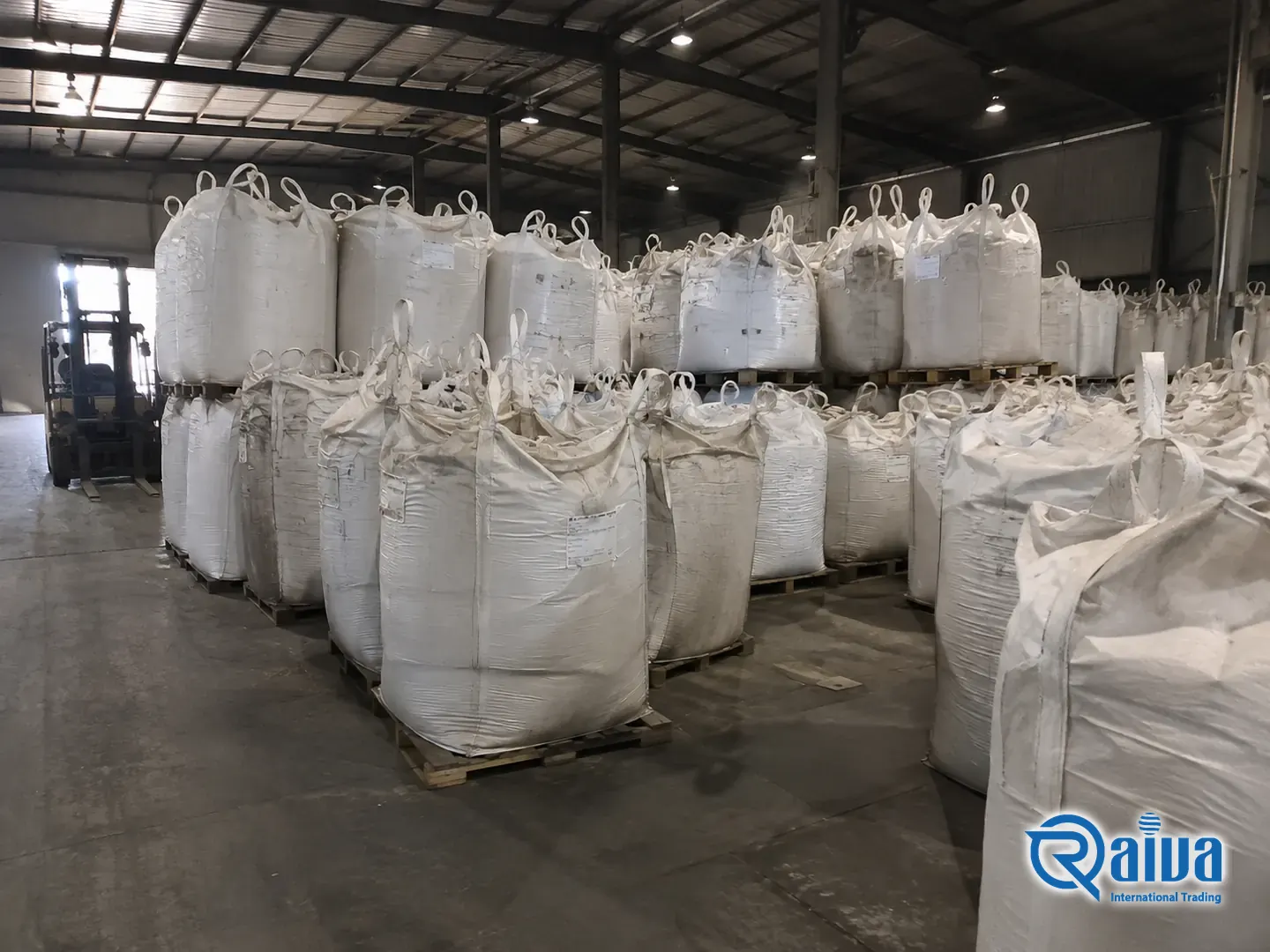
- Barite: bulk, 1–1.5 MT woven jumbo bags with single or four lifting loops, or 25 and 50 kg PP bags.
- Class G: 50 kg moisture-barrier bags, 1.5 MT jumbo bags or bulk pneumatic tanker; bulk delivery to wellsite silos on regional contracts.
| Item | Terms |
|---|---|
| Minimum order | 1 × 20 ft container (approx. 25 MT) bagged; 500 MT for a bulk vessel; trial quantities for qualification |
| Lead time | 7–14 days for standard grades after order confirmation |
| Certification | Barite: batch CoA to API 13A. Class G: batch API Spec 10A-2019 test report. SGS, Bureau Veritas or your inspector at the buyer's cost |
| HS code (6-digit) | Barite 2511.10; Class G cement 2523.29 — national subheadings vary |
Qualifying a new source
- Ask for the certificate of the lot offered, not a typical sheet, and check it against your programme.
- For barite, look past density: the viscosity after gypsum and the fine fraction below 6 µm decide how the mud behaves.
- For Class G, run your own slurry design with your additive package at the well's circulating temperature before the first job.
- Inspect at loading for large contracts; both products can be sampled by an independent inspector.