
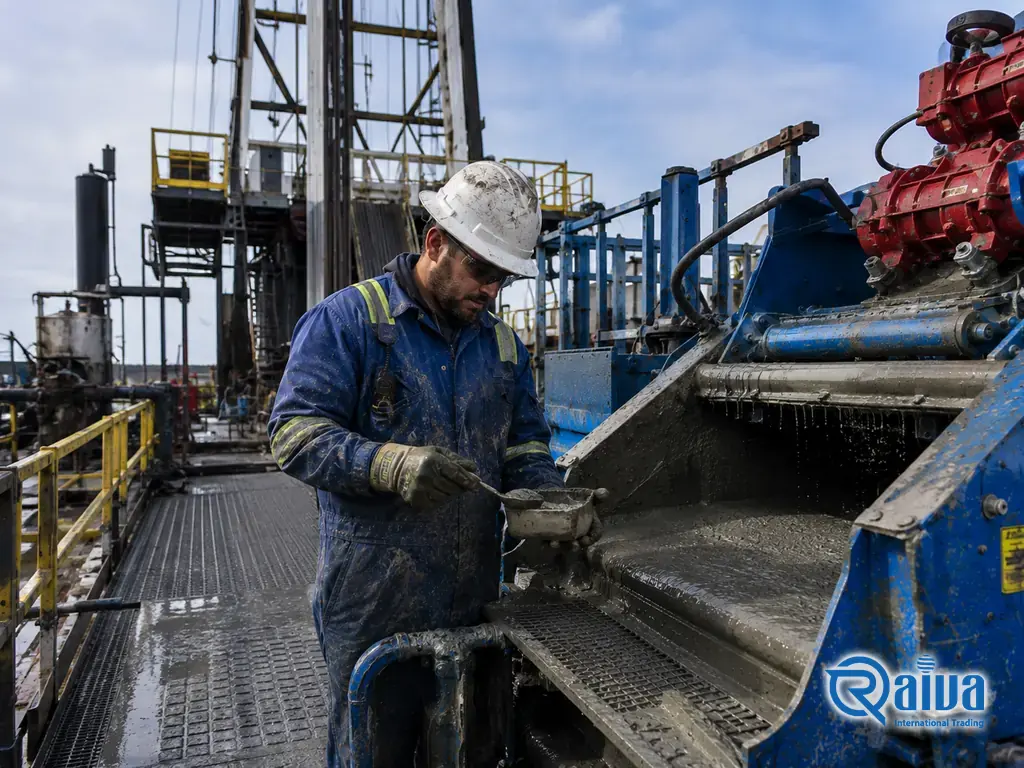
The rig-floor reality: anatomy of a barite sag event
In deep and extended-reach drilling, continuous hydrostatic balance is the frontline defence against a well control incident. During extended non-circulating operations — tripping for a worn bit, or running wireline logs across an inclined section — the drilling fluid stands completely still.
When the pumps are restarted to circulate bottoms-up, the mud logging unit often catches a sharp drop in active mud weight across the shale shakers: 12.5 ppg going to 11.3 ppg is a realistic reading rather than a worst case. That drop carries three consequences, and they arrive together:
- Hydrostatic head loss. An underbalanced column invites formation fluid influx. What began as a settling problem is now a kick.
- Cuttings and barite accumulation downhole. Torque and drag spike as the bed builds, and the probability of differential sticking rises with it.
- ECD swings. Equivalent circulating density becomes unpredictable — high enough to break down the formation, and the lost circulation that follows.
Crews reach first for polymer degradation or a viscosifier shortfall, because those are the levers available at the rig site. Laboratory root-cause work usually lands somewhere else: a particle size distribution outside the API envelope, or a specific gravity that never met the certificate in the first place. Neither is fixable with a sack of polymer.
The physics of sag: the Boycott effect at critical angles
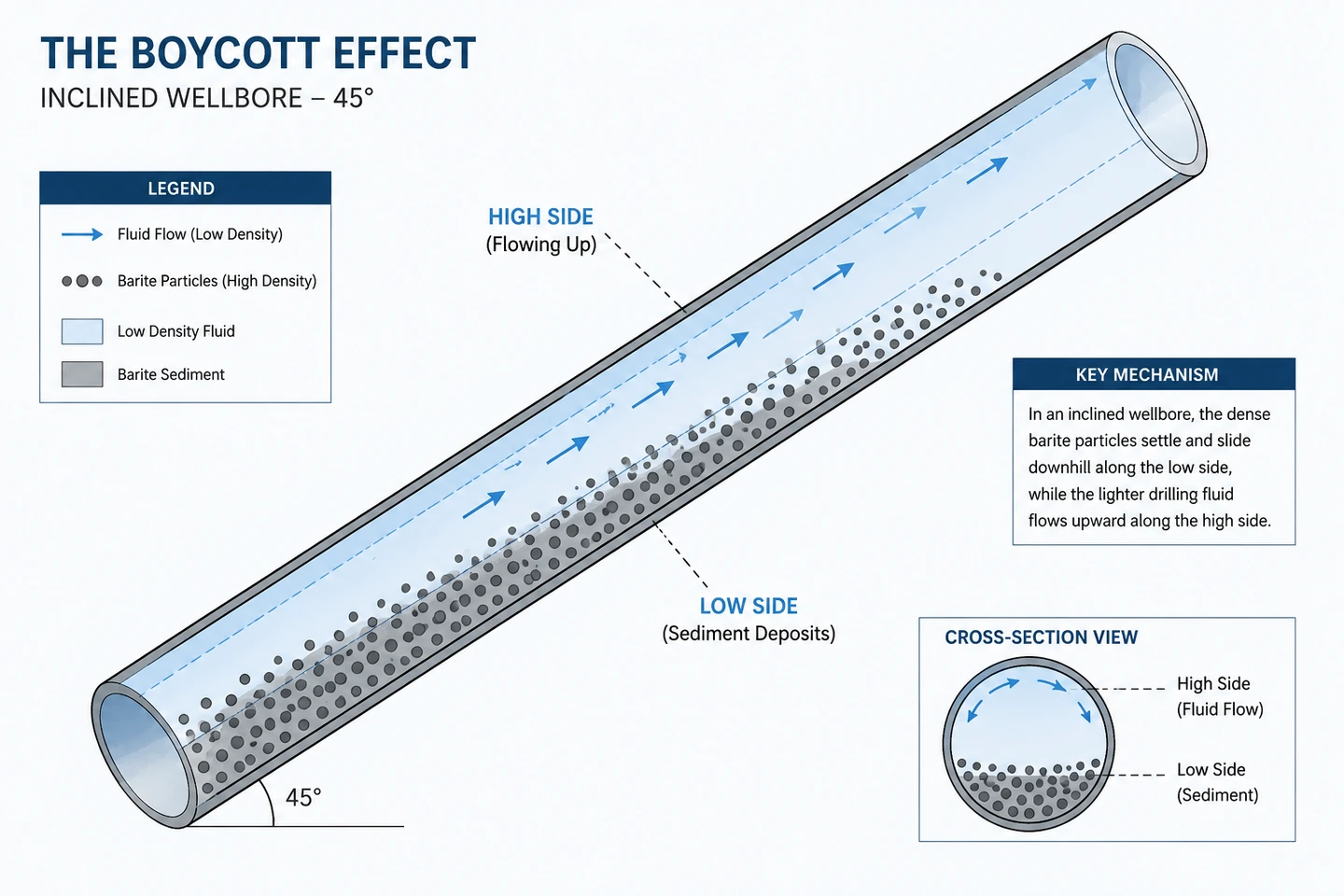
Settlement downhole is not the simple vertical Stokesian drop the textbook drawing suggests. Between 30° and 60° of inclination, a different mechanism takes over.
- The Boycott mechanism. A barite particle in an inclined annulus does not have to fall the length of the hole. It has to cross the annular gap — a fraction of an inch — to reach the low side. Once the dense solids gather there they form a concentrated bed that slides downhill, while the lighter fluid it displaced runs up the high side. The column stratifies far faster than settling velocity alone predicts, which is why sag is an angle problem before it is a density problem.
- Static against dynamic sag. Static sag happens while the rig is down. Dynamic sag happens during circulation at low shear — sliding, or drilling at low RPM — where the low-shear-rate viscosity (LSRV) is too weak to hold the particles up. Dynamic sag is the more dangerous of the two precisely because the pumps are running and the fluid looks like it is being managed.
Particle size distribution under API Spec 13A
Suspension is engineered at the mill, not at the mud pit. Two boundaries do most of the work, and they pull in opposite directions:
- The upper boundary — 75 µm, 200 mesh. API Spec 13A caps wet-sieve residue on a 75 µm screen at 3.0 wt%. Coarse particles are what start Boycott sliding in a high-angle interval, because they are the ones that cross the annular gap first. Holding residue under 1.8 wt% buys a noticeable margin of fluid stability over the specification minimum.
- The lower boundary — 6 µm ultrafines. The mass fraction below 6 µm must not exceed 30 wt%. This is the limit buyers most often ignore, because finer sounds safer. It is not: over-grinding multiplies specific surface area, and with it plastic viscosity, pump pressure, thermal degradation and a measurable loss of rate of penetration.
| Technical parameter | API 13A standard (4.20 grade) | Commercial low-grade barite | Downhole operational impact |
|---|---|---|---|
| Specific gravity (SG) | ≥ 4.20 g/cm³ | 3.95–4.10 g/cm³ | Lower SG needs more solids for the same mud weight, escalating ECD |
| Residue on 75 µm sieve | ≤ 3.0 wt% | > 4.5 wt% | Rapid settling, Boycott sliding, severe sag |
| Particles below 6 µm | ≤ 30.0 wt% | > 35.0 wt% | Excessive plastic viscosity and high pump pressures |
| Soluble alkaline earth metals | ≤ 250 mg/kg as calcium | > 400 mg/kg | Flocculates bentonite and degrades filtration-control polymers |
The commercial low-grade column is representative of off-specification material found during third-party inspection, not a published standard.
A barite that fails either boundary can still be sold as chemically compliant. Specific gravity and barium sulphate content say nothing about the shape of the distribution between them.
Laboratory QC: validating mineral purity batch by batch
The tests below are the ones worth insisting on before a cargo is released, because each catches a failure the others cannot see:
- Helium gas pycnometry. Absolute true specific gravity to two decimal places. It removes the volumetric error that liquid displacement carries on a porous, fine-milled powder — the error that lets a 4.13 pass as a 4.20.
- Laser diffraction PSD profiling. The full curve, not a pass/fail figure. A symmetrical distribution confirms the absence of both oversize grit and an ultrafine tail; two barites with identical sieve residue can behave completely differently downhole.
- Water-soluble alkaline earth metals. Dissolved calcium and magnesium held below the threshold, protecting the long-chain filtration-control polymers — PAC and CMC — that the rest of the mud programme depends on.
Logistics, packaging and supply chain assurance
Barite is heavy, cheap per tonne and ruined by water, which makes packaging a larger share of delivered quality than it is for almost any other mineral we ship.
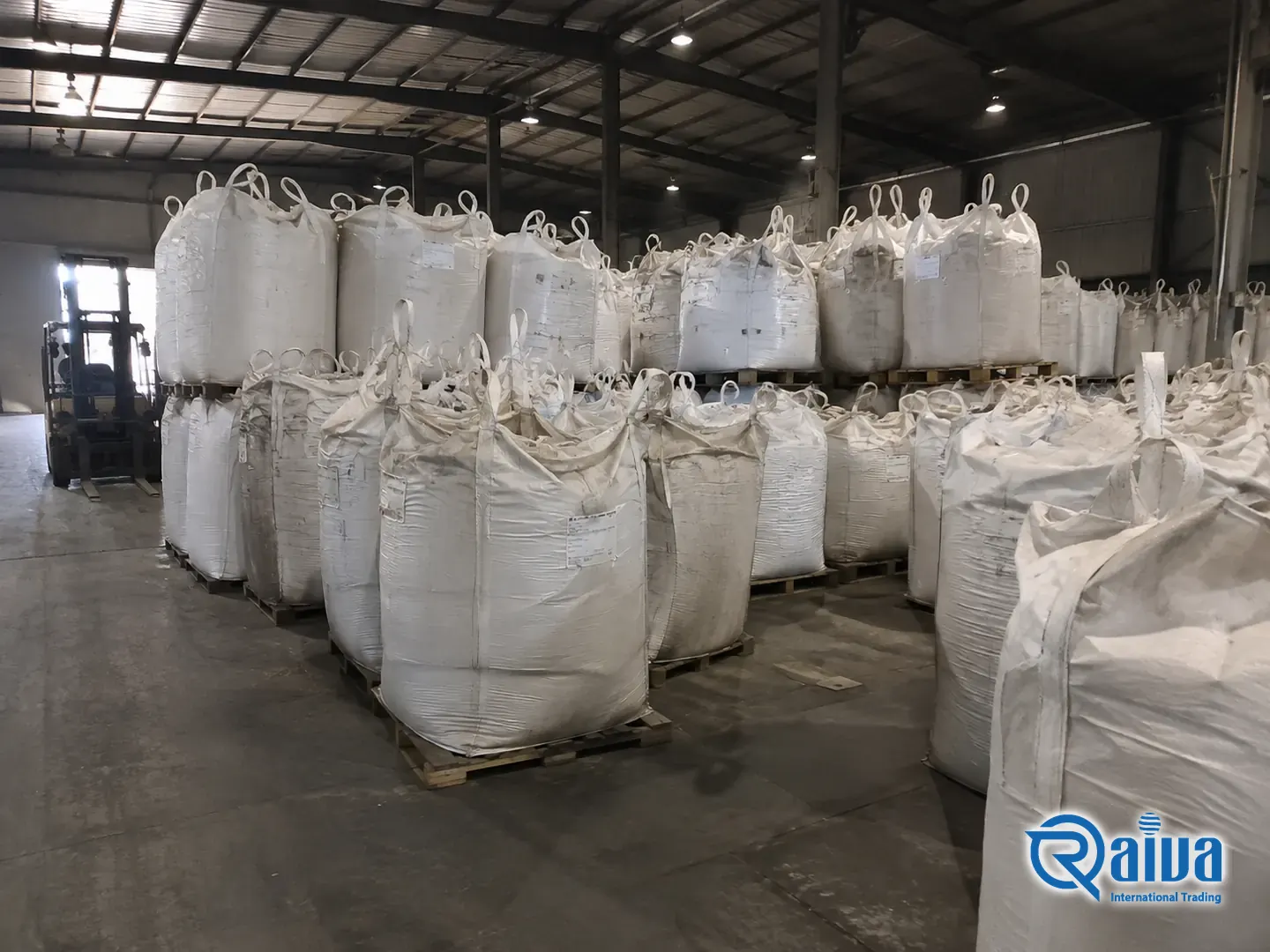
- Moisture-proof barrier packaging. 1.5-tonne UV-stabilised laminated FIBC bulk bags with inner polyethylene liners. The liner is the point: moisture ingress on a long sea leg causes caking, and a caked barite blocks the hopper before anyone has tested a gram of it.
- Batch-by-batch traceability. A certificate of analysis tied to the specific shipping lot, not to the grade in general, so third-party inspection by SGS or Bureau Veritas can be reconciled against what actually arrived.