

Feldspar Supplier & Exporter — Potassic, Sodic and Blended Grades
(K,Na)AlSi₃O₈ Alkali Feldspar · Total alkali 10.20 – 13.90%
Bulk feldspar in three chemistries off different working faces — a potassic grade at 11.80% K₂O with iron held to 0.14%, a sodic grade at 9.40% Na₂O for fast-fired porcelain tile, and a potassic–sodic blend for general body and glass batch. Supplied as lump, graded granular or micronized powder, with a batch-specific Certificate of Analysis per shipment.
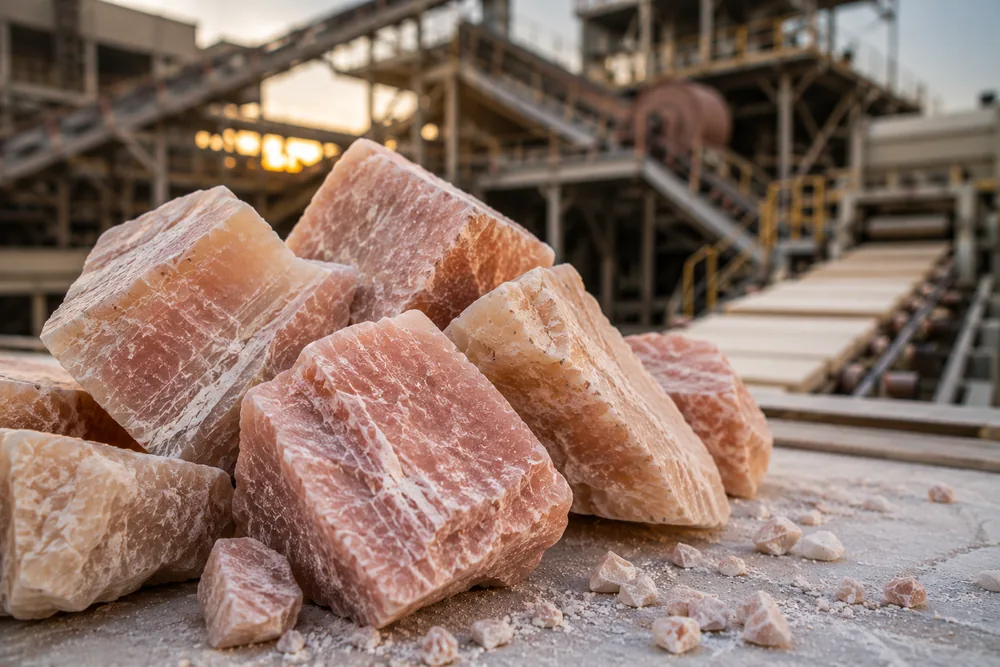 K₂O 11.80%
Supply capability at a glance
13.90%
Total alkali — potassic grade
0.14%
Fe₂O₃ — potassic grade
9.40%
Na₂O — sodic grade
Per batch
Certificate of Analysis
Physical Properties
Formula
(K,Na)AlSi₃O₈
Mineral
Orthoclase / Albite
HS Code
2529.10
Mohs Hardness
6
Total Alkali
10.20 – 13.90%
L.O.I
0.35 – 0.85%
Synonyms: Potash Feldspar, Potassium Feldspar, K-Spar, Soda Feldspar, Sodium Feldspar, Orthoclase, Albite, Alkali Feldspar · Off-white to pale pink lump, graded granular or micronized powder.
Six-digit WCO heading — national subheadings vary by destination.
Grades & Chemical Analysis
Three feldspars, split on which alkali dominates — which is the property that decides how the melt behaves, not how much of it there is. Potash melts stiff over a wide temperature range and suits glaze and slow-fired porcelain; soda melts lower and runs thinner, which is what a fast-fired tile line wants; the blend sits between the two. Select a grade to view its typical analysis.
Potassic Grade — Glaze, porcelain and technical ceramic bodies
Potassium Feldspar (K-Spar)
- K₂O
- 11.80%
- Total Alkali (K₂O + Na₂O)
- 13.90%
- SiO₂
- 67.40%
- Al₂O₃
- 17.85%
- Na₂O
- 2.10%
- Fe₂O₃
- 0.14%
- CaO
- 0.40%
- MgO
- 0.15%
- TiO₂
- 0.04%
- Loss on Ignition
- 0.35%
These are typical production analyses for the faces we ship from, not the result of a single certificate — feldspar is quarried, and the chemistry moves within a band across a working face. Oxide totals run 98.62–100.23%, which is ordinary for XRF once rounding and unreported trace oxides are allowed for. A batch-specific Certificate of Analysis with the actual figures is issued for every shipment.
Feldspar — Grade Comparison by Oxide
The three analyses side by side, which is how a body or glaze recipe is actually proportioned. Total alkali sets how much feldspar the batch needs; the split between potash and soda sets how wide the firing window is; and iron sets how white the fired piece can be.
| Oxide | Potassic | Sodic | Potassic–Sodic |
|---|---|---|---|
| SiO₂ | 67.40% | 69.50% | 70.80% |
| Al₂O₃ | 17.85% | 16.20% | 15.60% |
| K₂O | 11.80% | 1.10% | 2.40% |
| Na₂O | 2.10% | 9.40% | 7.80% |
| Total Alkali | 13.90% | 10.50% | 10.20% |
| K₂O : Na₂O | 5.6 : 1 | 1 : 8.5 | 1 : 3.3 |
| Fe₂O₃ | 0.14% | 0.25% | 0.32% |
| CaO | 0.40% | 1.10% | 0.90% |
| MgO | 0.15% | 0.30% | — |
| TiO₂ | 0.04% | 0.07% | — |
| Loss on Ignition | 0.35% | 0.70% | 0.85% |
Total alkali and the potash-to-soda ratio are arithmetic on the two alkali figures above them, not separately measured values; the ratio is rounded to one decimal. A dash marks an oxide the blended grade’s analysis does not report — it is not a zero, and it has not been filled in from the other two columns. Where MgO or TiO₂ matters to your body, ask for it on the batch certificate at enquiry stage.
Bespoke Production
Need a tighter iron ceiling or a specific micron cut?
If none of the grades above matches your target chemistry, fineness, or packaging, tell us your requirements — we produce custom grades to your exact specification.
Applications
Feldspar is bought for the alkali it carries and the iron it does not. Which of the two alkalis dominates decides how wide the firing window is and how the melt behaves once it opens.
Flat & Container Glass
Alkali and alumina source; drops the batch melting point and cuts furnace fuel.
Porcelain Tile & Sanitaryware
Vitrifying flux forming the glassy phase that closes porosity in the body.
Tableware & Technical Porcelain
Body flux fired to translucency, where iron decides the achievable whiteness.
Glazes & Frits
Principal flux and glass former in raw glaze and frit recipes.
Welding Electrode Coating
Arc stabiliser and slag former in the flux coating of covered electrodes.
Fillers & Extenders
Low oil-absorption extender in paint, plastics, rubber and adhesive compounds.
Packaging, Logistics & Trading Terms
How we crush, grade, certify and ship feldspar. Terms can be adapted by agreement — tell us what your operation needs.
- Minimum Order Quantity
- 1 × 20 ft container (approx. 25 MT) bagged. 500 MT minimum for bulk vessel. Trial quantities available for qualification.
- Packaging
- 25 kg and 50 kg PP bags, 1–1.5 MT woven jumbo bags, or bulk. Lump and graded granular ship in bulk; micronized grades are bagged with a moisture-barrier liner on request.
- Incoterms & Loading Ports
- EXW, FOB, CFR and CIF (Incoterms® 2020) by sea, with standard loading at Bandar Abbas and Bandar Imam Khomeini; other ports by arrangement. DAP and FCA overland, by truck and rail through Iran’s land borders.
- Quality Certification
- Batch-specific CoA with every shipment covering K₂O, Na₂O, Al₂O₃, Fe₂O₃ and loss on ignition. SGS / Bureau Veritas inspection at buyer’s cost.
- Lead Time
- 7–14 days for standard grades after order confirmation; 15–25 days for custom-milled or specially packed material.
- Storage & Handling
- Store under cover and keep dry. Feldspar is chemically inert and has no shelf-life limit, but damp powder cakes in the bag and will not disperse into a slip or a glaze suspension until it has been re-milled. Keep lump off bare ground — iron-bearing dirt picked up in the yard ends up in the mill, and the whole reason to buy a 0.14% iron feldspar is to keep it out.
Certificate of Analysis
A batch-specific CoA is issued with every shipment. Third-party inspection by SGS, Bureau Veritas or an inspector of your choice can be arranged at the buyer’s cost.
Ready to quote
Send us your grade, tonnage, destination port and packaging and we will return a firm FOB/CFR/CIF price with lead time.
Request a Feldspar Quote