

Three numbers decide the purchase
Glass furnaces and tile kilns ask different things of their raw materials, but the purchase comes down to the same short list on every analysis sheet:
- Iron (Fe₂O₃) in all three. It is the oxide that puts a green cast into glass and a cream or buff tone into a fired body, and nothing downstream removes it. Agree an iron ceiling before you agree a grade.
- Alkali in feldspar. Total K₂O plus Na₂O sets how much feldspar a batch needs; the split between potash and soda sets how the melt behaves and how wide the firing window is.
- Alumina in kaolin. Al₂O₃ gives the body its refractoriness and fired strength; iron and titania between them decide how white it fires.
Silica for the glass batch: buy it on iron
Silica is the batch former in flat and container glass, and above roughly 98% SiO₂ the purchase is decided on iron rather than on silica. The published analysis shows why: the purest sample is not the one with the least iron.
| Sample and grade | SiO₂ | Fe₂O₃ | Al₂O₃ | Where it fits |
|---|---|---|---|---|
| S501 — high-purity quartz | 99.71% | 0.10% | 0.070% | Highest silica; flat and container glass |
| S502 — high-purity quartz | 99.56% | 0.06% | 0.12% | Low-iron option where clarity matters |
| S507 — high-purity quartz | 98.57% | 0.05% | 1.16% | Lowest iron; carries more alumina |
| S510 — glass-batch silica | 95.41% | 0.21% | 2.38% | Container and pressed glass |
| S509, S506 — feldspathic sand | 79.90–89.10% | 0.26–0.28% | 6.07–14.05% | Ceramic body and glaze, not glass |
Every figure is a certified sample value from the published analysis sheet, not a blended average. Iron across the high-purity samples runs from 0.05% to 0.67%, so the seam matters: give us your iron ceiling and we quote only against the seams that hold it. The feldspathic sand is sold as a ceramic raw material — its alumina and alkali are a defect in a glass batch and the reason to buy it for a tile body.
Product specification Silica: high-purity quartz, glass-batch and feldspathic grades Ten certified samples from 79.90% to 99.71% SiO₂, with iron, alumina and alkali for each.Feldspar for tile bodies and glazes: potash or soda
Feldspar is the flux that forms the glassy phase in a porcelain tile body and drops the melting point of a glass batch. Which alkali dominates is the property that matters. Potash feldspar melts to a stiffer glass over a wide temperature range, which suits glazes and slow-fired porcelain. Soda feldspar melts lower and runs thinner, which is what a fast-fired porcelain tile line is built around.
| Oxide | Potassic | Sodic | Potassic–sodic |
|---|---|---|---|
| K₂O | 11.80% | 1.10% | 2.40% |
| Na₂O | 2.10% | 9.40% | 7.80% |
| Total alkali | 13.90% | 10.50% | 10.20% |
| Al₂O₃ | 17.85% | 16.20% | 15.60% |
| Fe₂O₃ | 0.14% | 0.25% | 0.32% |
| Best suited to | Glaze, slow-fired porcelain | Fast-fired porcelain tile, sanitaryware | General body, glass batch |
These are typical production analyses for the working faces we ship from, not a single certificate: feldspar is quarried and its chemistry moves within a band. Each shipment goes out against a batch-specific Certificate of Analysis carrying its actual figures, which is also why a trial lot fired in your own body is the sensible way to qualify it.
Product specification Feldspar: potassic, sodic and blended grades Typical oxide analyses side by side, total alkali, the potash-to-soda ratio and iron for each grade.Kaolin for the body: alumina for strength, iron for whiteness
Kaolin is the plastic body former in porcelain tile, sanitaryware and tableware. Its published analysis:
- Al₂O₃ 20.28% against SiO₂ 67.66% — the alumina that sets refractoriness and fired strength.
- Fe₂O₃ 0.15% and TiO₂ 0.20% — the two oxides that discolour a fired body.
- Loss on ignition 9.48%, determined by ED-XRF — the chemically bound water driven off in firing.
- Supplied as lump (40 mm minimum, as quarried and washed) or milled to the mesh or micron cut your process specifies. Calcination is arranged to order.
Fired whiteness is measured on a fired test piece, not inferred from chemistry. If you work to a brightness target, send it with your firing schedule and we confirm it against your conditions rather than promise a number in advance.
Product specification Kaolin (china clay) for ceramic bodies Al₂O₃ 20.28%, Fe₂O₃ 0.15%, TiO₂ 0.20% — the full oxide analysis, lump or milled.Getting it to Turkey: overland or by sea
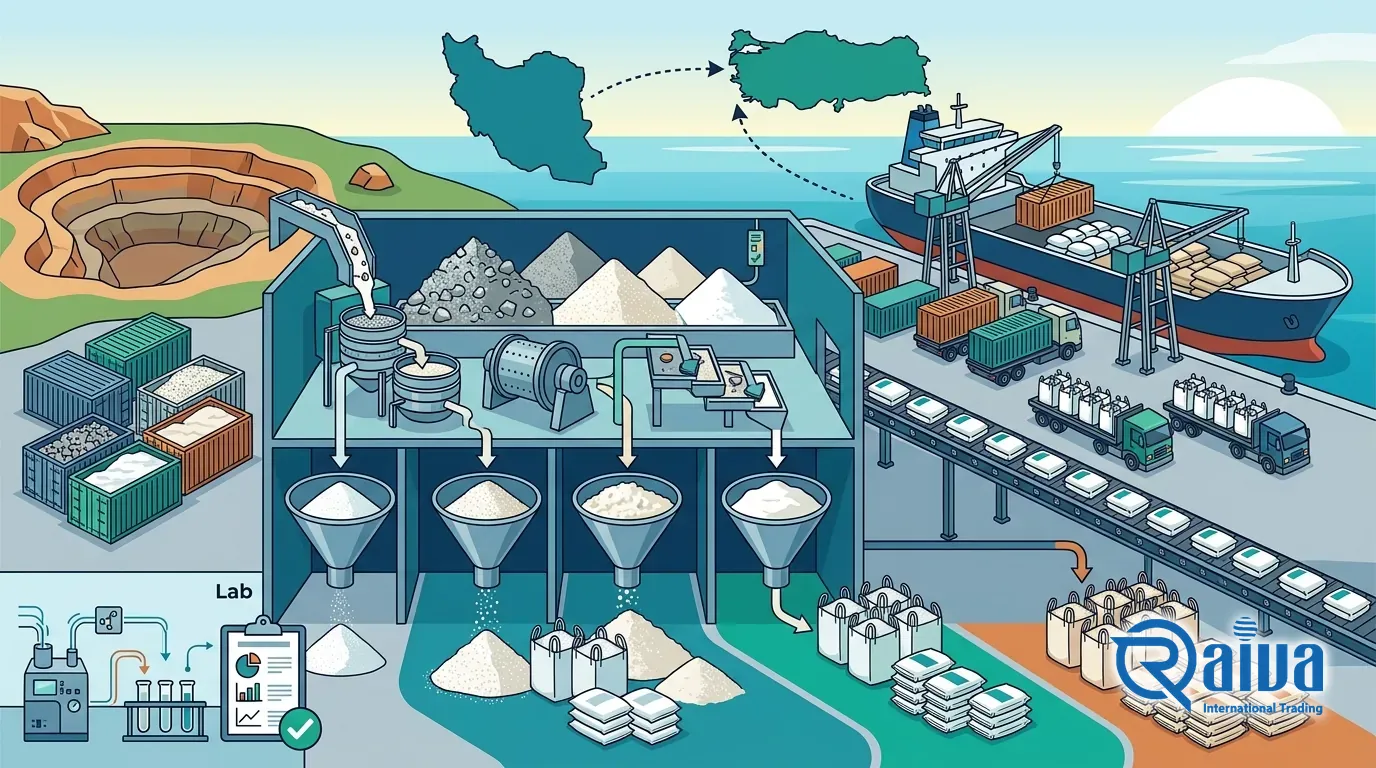
Iran shares a land border with Turkey, so for most plants the shorter route is overland rather than by sea:
- Overland, DAP or FCA. By truck and rail through Iran's land borders — the usual choice for container-sized and repeat orders.
- By sea, EXW, FOB, CFR or CIF (Incoterms® 2020), with standard loading at Bandar Abbas and Bandar Imam Khomeini; other ports by arrangement. This route makes sense for bulk vessel lots.
| Item | Terms |
|---|---|
| Minimum order | 1 × 20 ft container (approx. 25 MT) bagged; 500 MT for a bulk vessel; trial quantities for qualification |
| Packaging | 25 kg and 50 kg PP bags, 1–1.5 MT woven jumbo bags, or bulk; moisture-barrier liner on request for milled grades |
| Lead time | 7–14 days for standard grades after order confirmation; 15–25 days for custom-milled or specially packed material |
| Certification | Batch-specific Certificate of Analysis with every shipment; SGS, Bureau Veritas or your own inspector at the buyer's cost |
| HS code (6-digit) | Silica 2505.10 (sand) or 2506.10 (quartz); feldspar 2529.10; kaolin 2507.00 — national subheadings vary |
Qualifying a new supplier without stopping the line
Switching a body or batch recipe to a new source is a production risk, so qualify the material before the contract, not after it:
- Send your limits, not just the grade name. An iron ceiling, a K₂O:Na₂O range or a screen cut lets us quote only against material that holds it.
- Fire a trial lot in your own body or furnace. Trial quantities exist for exactly this; a laboratory number does not tell you how the material behaves on your kiln curve.
- Compare each certificate with the contract. The batch CoA, not the published typical values, is the document the cargo is accepted against.
- Inspect at loading if the volume justifies it. Third-party inspection can be arranged at the loading point for large contracts.