

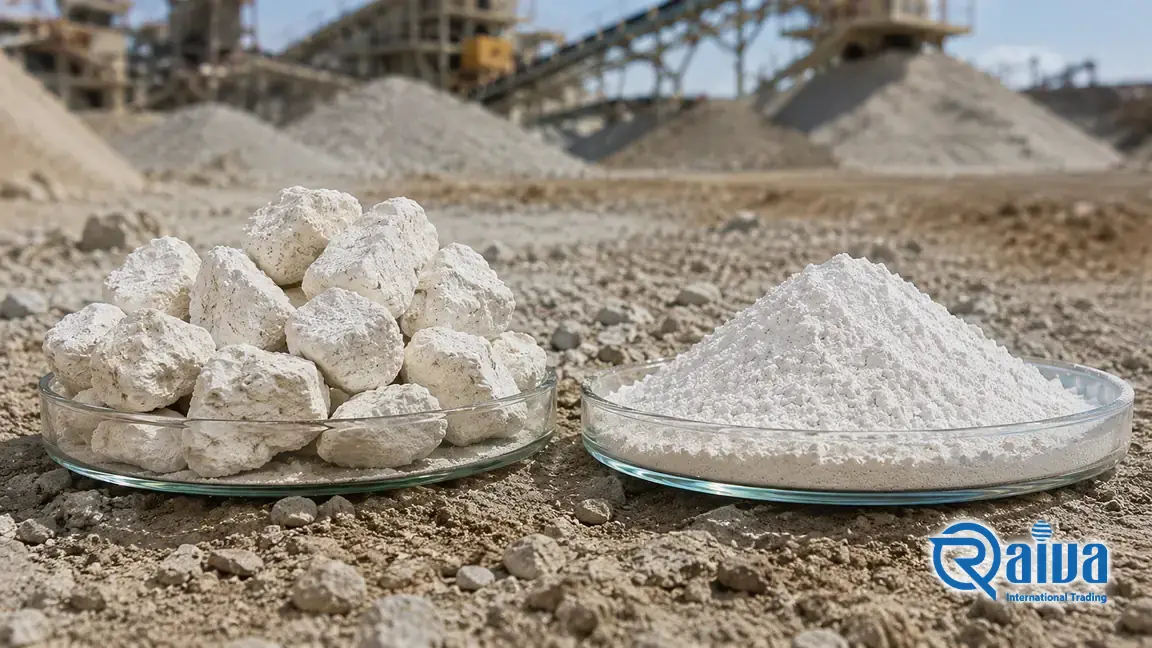
Quicklime and hydrated lime come out of the same quarry. One kiln pass and one controlled addition of water separate them — and that single step changes reactivity, bulk density, the handling regime, and about a third of the alkalinity delivered per tonne of freight.
Purchasing teams that treat CaO and Ca(OH)₂ as one commodity called lime usually find the difference at the worst possible moment: a blocked injection lance, a slaker running away, or a stabilised subgrade that never reaches its design CBR. The comparison below uses the figures that appear on our own certificates of analysis rather than textbook values.
One rock, two products: what the kiln and the hydrator actually change
Both materials begin as high-calcium limestone. The chemistry is short; the consequences are not.
Calcination — limestone to quicklime
CaCO3 + ΔH → CaO + CO2 ↑
Endothermic, roughly 178 kJ per mole, run industrially between 900 °C and 1,250 °C in vertical shaft or rotary kilns. What leaves the kiln is a porous, strongly hygroscopic calcium oxide — quicklime, burnt lime or unslaked lime.
Hydration — quicklime to hydrated lime
CaO + H2O → Ca(OH)2 + 1,140 kJ/kg
Exothermic, releasing on the order of 1,100 kJ for every kilogram of CaO converted. Carried out under stoichiometric water control in a hydrator, it yields a dry, free-flowing micronised powder — even though roughly 24% of that powder's mass is now chemically bound water.
The variable most often left out of a purchase specification is degree of burning. A soft-burnt lime keeps its pore structure and reacts quickly; an over-burnt (hard- or dead-burnt) lime has had that porosity sintered shut and reacts sluggishly at identical CaO content. A buyer who specifies CaO ≥ 90% and nothing else can legitimately be shipped a chemically compliant, industrially useless lime. Specify reactivity alongside purity — EN 459-2 reports it as t₆₀, the time a standard slaking test takes to reach 60 °C.
Grade-by-grade technical comparison
The three columns below are the grades most often quoted for export. The figures are typical certificate-of-analysis ranges, not marketing rounding.
| Parameter | Quicklime (CaO) | Hydrated lime — Special, Mesh 400 | Hydrated lime — General, Mesh 250 |
|---|---|---|---|
| Chemical formula | CaO | Ca(OH)₂ | Ca(OH)₂ |
| Main purity | CaO 90–92% (Mesh 170 / R170) | Ca(OH)₂ 95–96.5% | Ca(OH)₂ 90–93% |
| Available lime (as CaO) | min. 85% (Milled Super-90 / R175) | 72–73.1% | 68.2–70.5% |
| Sieve residue | max 10% on Mesh 170 (88 µm) | max 5% on Mesh 400 (37 µm) | max 8% on Mesh 100 (149 µm) |
| Form and sizing | Mesh 170 powder or 2–6 cm lump | Ultra-fine micronised powder | Uniform free-flowing powder |
| Silica, SiO₂ | < 0.7% | < 0.2% | < 0.3% |
| Neutralising value (CaCO₃ equivalent) | ≈ 178% | ≈ 135% | ≈ 135% |
| Bulk density, typical | 0.9–1.1 t/m³ powder; 1.5–1.6 t/m³ lump | 0.40–0.50 t/m³ | 0.45–0.55 t/m³ |
| Behaviour with water | Strongly exothermic; t₆₀ under 5 min in reactive grades | Thermally inert; disperses as a suspension | Thermally inert; disperses as a suspension |
Two of those rows are the same number seen from different angles. Pure Ca(OH)₂ is 75.7% CaO by mass, so a 95% hydrate corresponds to about 72% available lime — exactly the figure in the Mesh 400 column. Available lime, measured by rapid sugar titration under ASTM C25, is the commercially meaningful number: total CaO also counts calcium already locked up as carbonate or silicate, which will never react in your process.
Steel and metallurgy: a kinetics problem, not a tonnage problem
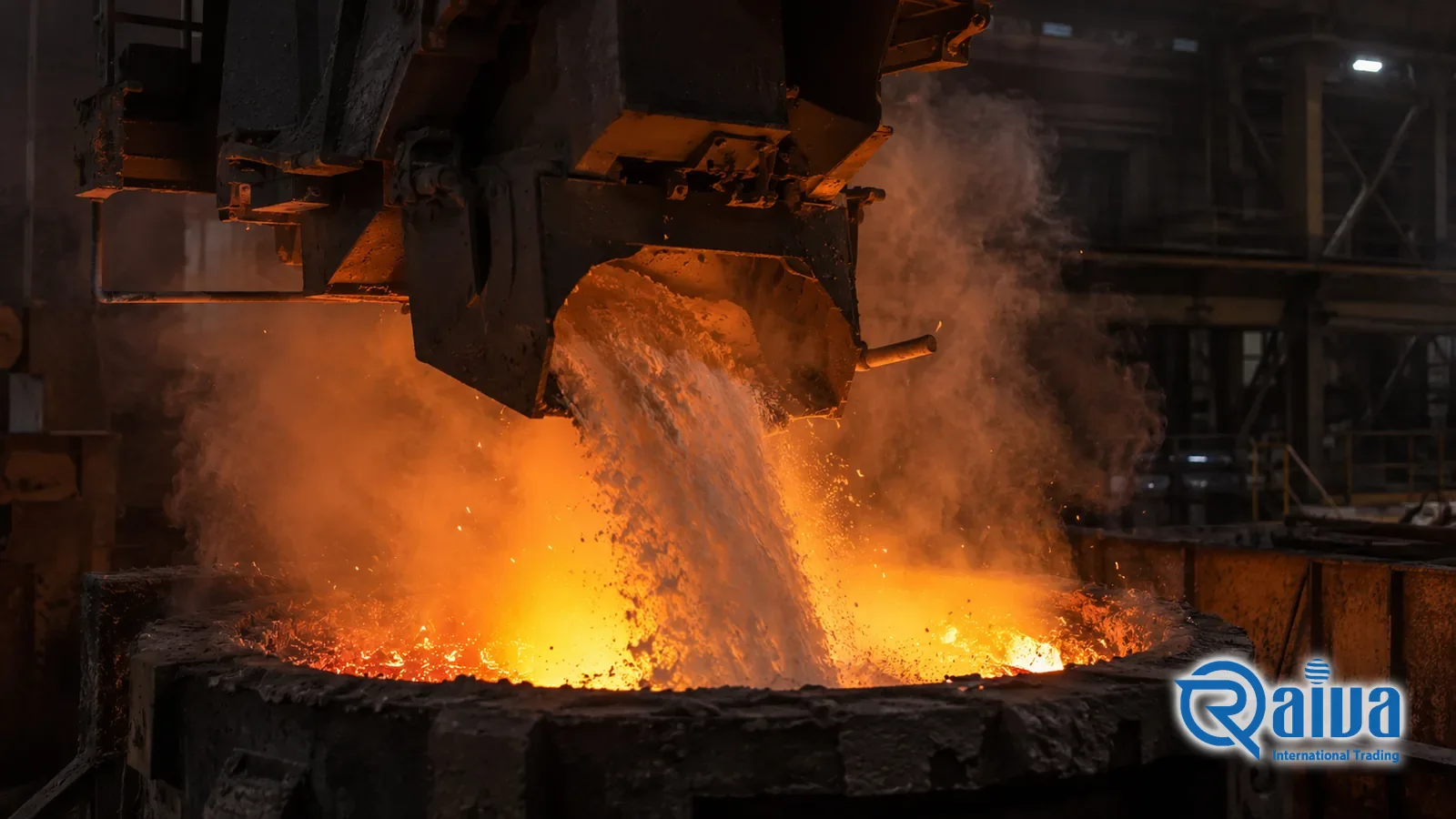
In an electric arc furnace or a ladle furnace, lime is the slag former that sets basicity (B₂ = CaO/SiO₂). Dephosphorisation happens in the oxidising EAF slag at high basicity and comparatively low temperature; desulphurisation happens later in the ladle, under a reducing high-basicity slag. Both are limited by how fast lime dissolves into the slag, not by how much lime sits in the charge bucket.
That makes grade choice a question of kinetics and impurities:
- Milled Super-90 (R175) — minimum 85% available CaO with a sub-five-minute t₆₀. It dissolves early, builds a foaming slag sooner and shortens power-on time, which is where the energy saving actually comes from.
- Mesh 170 (R170) — 90–92% CaO, suited to pneumatic injection where a consistent, fine, dry powder is required.
- Silica below 0.7% — every unit of SiO₂ arriving in the flux consumes CaO to form dicalcium silicate and pulls the slag away from MgO saturation, which measurably accelerates wear on a magnesia-carbon lining.
- Lump, 2–6 cm — still the right product for charge-bucket addition in shops without injection lances, where a fine powder would largely be lost to the fume system.
Water, wastewater and flue gas: where hydrated lime wins on control
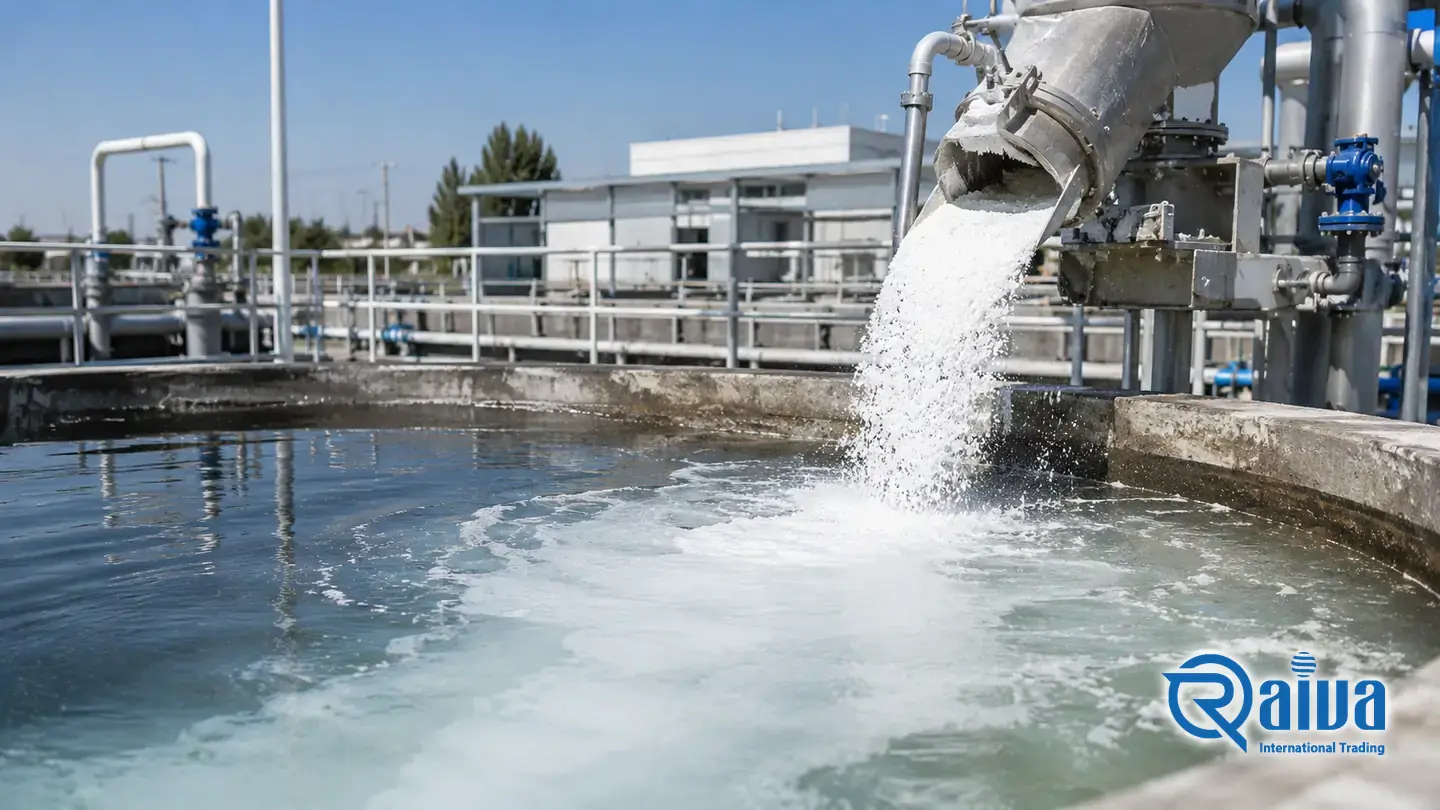
In neutralisation basins and treatment plants the objectives are pH correction, alkalinity control, softening, precipitation of heavy metals as hydroxides, phosphate removal and sludge conditioning. None of them benefit from an exotherm in the dosing line, and few plants want to own a slaker, its grit stream and its maintenance schedule.
Fineness governs everything here. Calcium hydroxide is only about 1.7 g/L soluble at 20 °C, and its solubility is retrograde — it falls as the water warms. In practice you are dosing a suspension, and the particle size distribution decides whether the solid dissolves in the contact tank or settles in the pipework.
- Mesh 400 Special — 95–96.5% Ca(OH)₂ with a maximum 5% residue above 37 µm. Highest specific surface, fastest neutralisation, and the lowest grit load on diaphragm pumps and injection nozzles.
- Mesh 250 General — the economical choice for large-volume pH correction and lime-milk preparation where nozzle tolerances are less tight.
- Dry sorbent injection — the same fineness argument applies to SO₂ and HCl capture in flue gas, where residence time is measured in seconds and only the outer layer of a coarse particle ever reacts.
Soil stabilisation: here the exotherm is the product
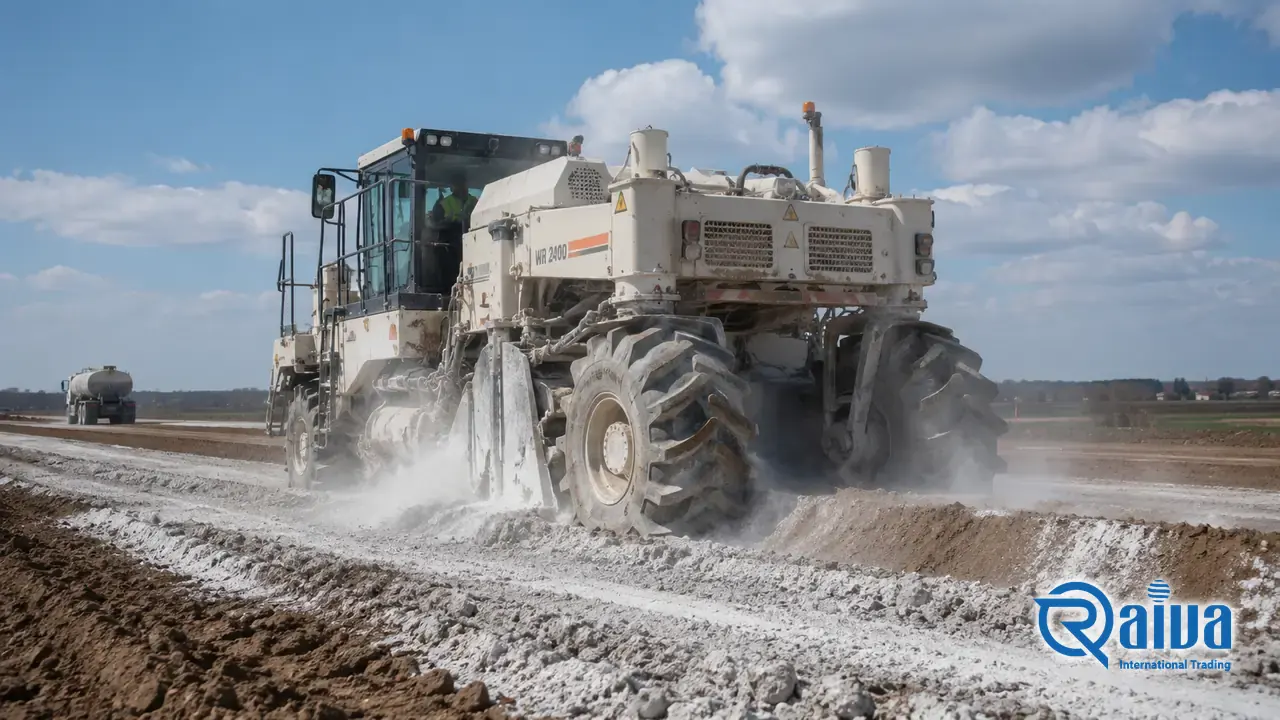
Two mechanisms are routinely confused on site, and they run on completely different clocks.
- Modification, within hours. Calcium ions exchange onto the clay surface, the platelets flocculate, plasticity index drops and the material becomes workable. Quicklime adds a third effect the hydrate cannot: it consumes about 0.32 kg of water per kilogram of CaO stoichiometrically and drives off more through its own heat of hydration. On a saturated subgrade, that drying effect is the reason to buy CaO in the first place.
- Pozzolanic stabilisation, over weeks and months. At the pH of about 12.4 that lime holds, silica and alumina dissolve out of the clay and combine with calcium to form calcium silicate and calcium aluminate hydrates. This slow cementing — not the initial drying — is what raises unconfined compressive strength and CBR.
Design the dosage, do not guess it. The Eades and Grady test (ASTM D6276) fixes lime demand as the lowest addition that still holds pH 12.4 after one hour; typical construction dosages then land between 2% and 6% of dry soil weight, but the test governs, and sulphate-bearing soils need specific checking for ettringite-related heave.
Selection follows the site: quicklime Mesh 70 for wet, high-plasticity clays where the drying effect is wanted; hydrated lime Mesh 250 for urban work, slurry application, or anywhere dust drift and caustic burn risk must be kept down.
The freight arithmetic most buyers skip
Converting one tonne of CaO produces about 1.32 tonnes of Ca(OH)₂, because the hydroxide carries a water molecule the oxide does not. Turn that around and a tonne of quicklime delivers roughly 32% more neutralising capacity than a tonne of hydrated lime — 178% CaCO₃ equivalent against 135%.
The volume gap is wider still. Hydrated lime powder stows at 0.4–0.5 t/m³ against 1.5–1.6 t/m³ for quicklime lump, so on a long sea leg you can be paying for close to three times the cubic metres per tonne of delivered alkalinity.
The counterweight is that buying CaO means owning the slaking step: the exotherm, the grit, and the water quality — slaking with hard or sulphate-rich water produces a visibly poorer hydrate. Quicklime also begins air-slaking the moment a bag is opened. As a rule, continuous high-volume consumers with a slaker on site buy CaO; intermittent, dosing-critical or logistics-constrained consumers buy Ca(OH)₂.
Why Iranian lime competes on the export market
Lime quality is capped at the quarry, not at the kiln — no amount of thermal control burns impurities out of a poor feedstock. Iran's advantage starts there.
- Feedstock. The high-calcium deposits feeding the main Iranian kilns commonly assay above 98% CaCO₃, which is what makes CaO in the low nineties and SiO₂ under 0.7% routine rather than exceptional.
- Low iron and silica. Fe₂O₃ and SiO₂ in Iranian export analyses sit at the clean end of the international range — the parameters that decide refractory life in steelmaking and whiteness in filler applications.
- Energy cost. Calcination is energy-intensive, and domestic energy pricing is the single largest reason Iranian CaO and Ca(OH)₂ land competitively even after freight.
- Packaging. Double-walled laminated jumbo bags matter more for lime than for almost any other mineral: quicklime air-slakes and hydrated lime carbonates, both silently, both in transit.
- Grades held. Quicklime as Mesh 70, Mesh 170 (R170), Milled Super-90 (R175) and screened 2–6 cm lump; hydrated lime as Mesh 400 Special, Mesh 250 General and Mesh 200 Alborz at a 93.46 whiteness index.
Storage, handling and one common safety error
- Quicklime. It reacts exothermically with moisture, including atmospheric humidity. Store sealed, dry, off the floor and away from water lines. Air-slaked lime loses reactivity irreversibly, and the heat of an accidental slaking makes skin or eye contact considerably worse than the chemistry alone would suggest.
- Hydrated lime. It is thermally inert. It is not chemically inert, and that distinction is frequently stated incorrectly. A saturated Ca(OH)₂ solution sits at pH 12.4 and is caustic to skin, eyes and the respiratory tract, so full PPE applies to both products. What ages hydrated lime is carbonation — Ca(OH)₂ reacting with atmospheric CO₂ to form CaCO₃ and water, quietly turning your alkalinity into inert filler.
- Both. Bag integrity is the real shelf-life variable. Where a shipment has spent months in a humid port, verify available lime on arrival rather than relying on the loading certificate.
Four questions that settle the choice
- Does the process want heat, or does heat hurt it? Wet subgrade or fast slag formation: quicklime. Dosing line, closed reactor, potable water: hydrated lime.
- Is there a slaker and a grit-handling route on site? If not, the freight saving on CaO is not a saving.
- Does the powder pass through fine nozzles, lances or diaphragm pumps? If yes, specify Mesh 400 and a sieve residue limit, not just a purity figure.
- Is freight a material share of the landed cost? On long routes, buying alkalinity rather than tonnage favours quicklime by roughly a third.